
Kiowa County VINELink Coverage
OK VINE is Oklahoma’s free, confidential custody-information and notification service. The Oklahoma Attorney General describes statewide service across all 77 counties and information from arrest through sentencing to release. A user may search and register without being the crime victim. Access is available through VINELink and by phone at 1-877-654-8463.
Coverage does not mean every local field is present or instant. Each result must be tied to its contributing agency or facility. Kiowa County Jail and ODOC events can belong in the statewide flow, but the exact labels vary by contributor. Research did not bypass account prompts or infer fields that were not observed. A no-match is inconclusive because spelling, lag, transfer, an unsupported facility, or record limits may explain it.
The official OK VINE overview shown below establishes the statewide channel.
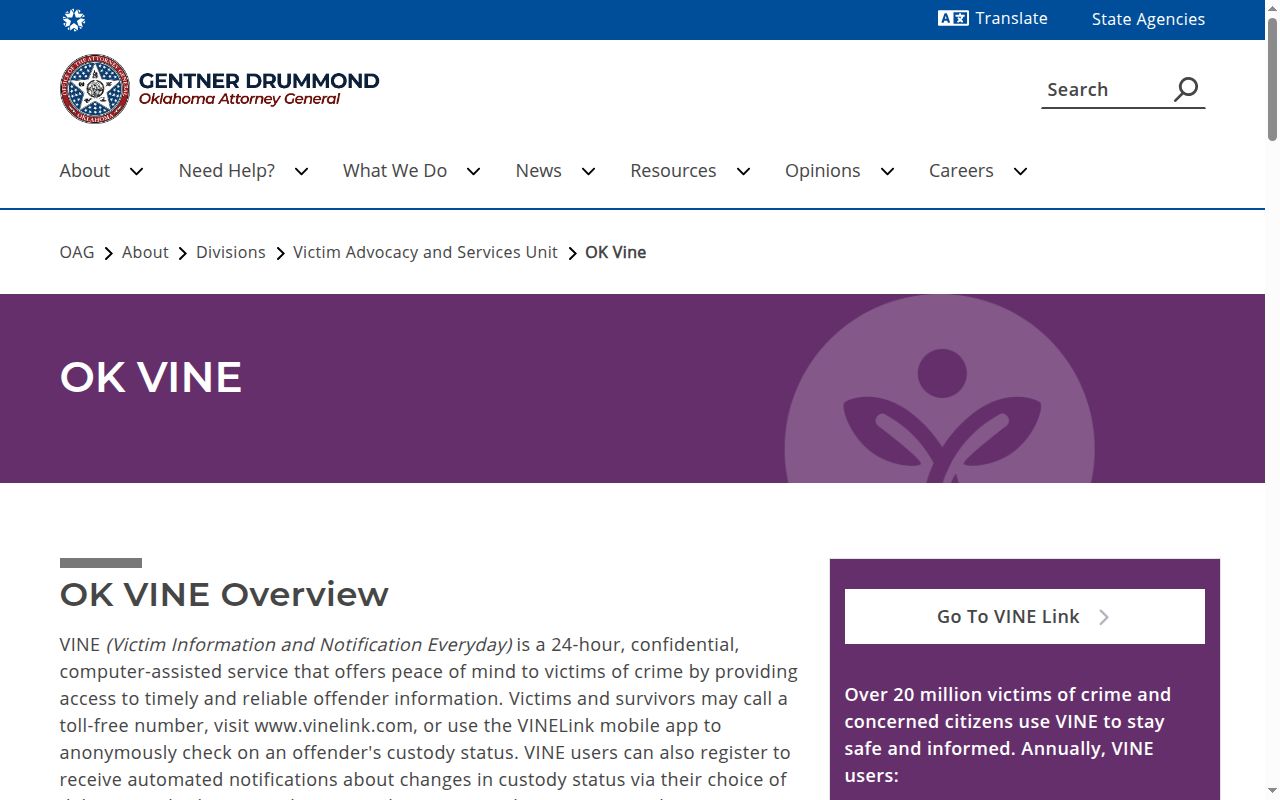
The state page is the right starting point for Oklahoma coverage and the toll-free service, not a similarly named private or out-of-state roster.
Search Kiowa County VINELink Records
Start with a known name or identifying number. An ID is usually the cleaner key, while a name search may return several people. Narrow with the identifiers that the live system offers, then compare the reporting agency and facility. Do not select a result merely because the name looks familiar. A same-name person in another county or state is a different record.
- Open VINELink for Oklahoma and choose the offender or custody search.
- Enter the person’s name or known identifying number. Use available narrowing details to reduce false matches.
- Compare identity details, the reporting agency, and facility before opening the record.
- Read the exact custody-status label and event date. Record the words shown rather than substituting a preferred term.
- If the event reports release or transfer, contact the contributing sheriff, jail, or ODOC office for the manner and documentary record.
The official Oklahoma VINELink result channel shown below contains no user-entered notification contact information.
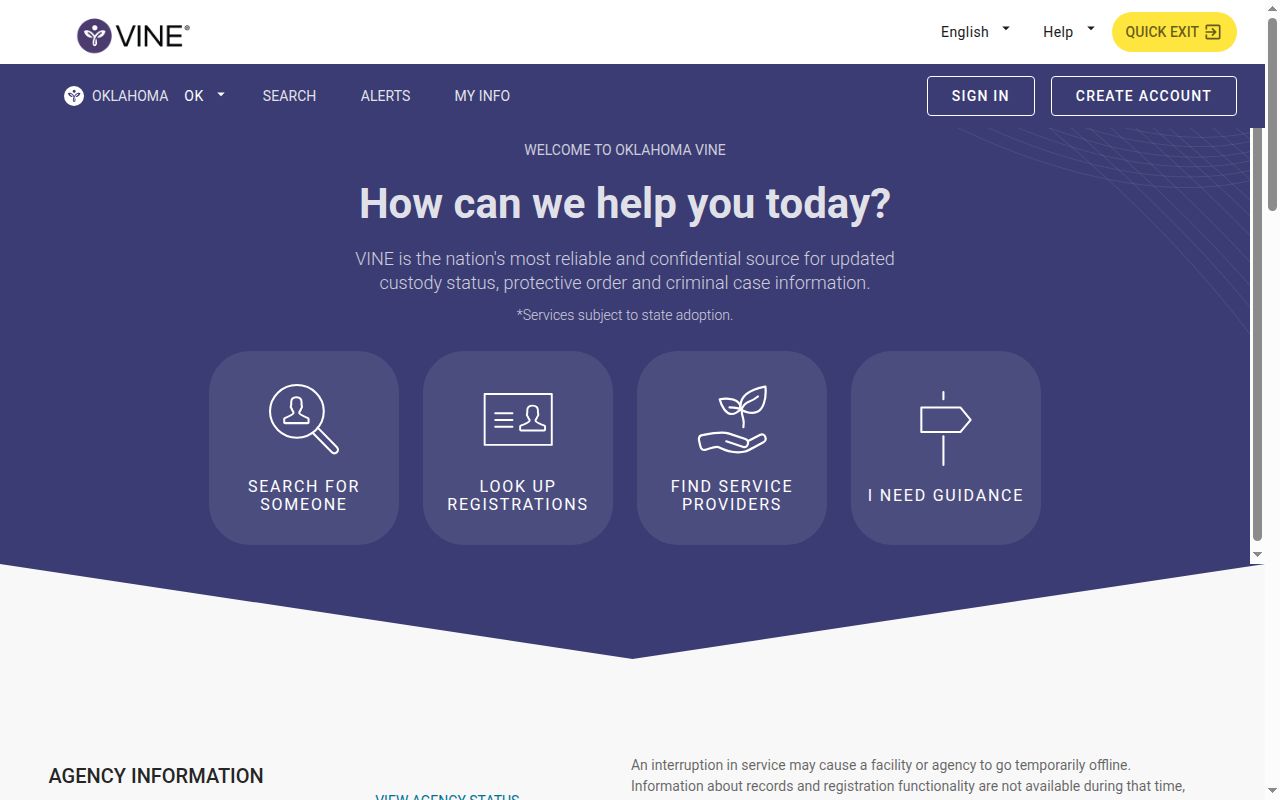
The result screen is a discovery and alert record. The agency named there controls the event that needs confirmation.
For a Kiowa-only booking, call the sheriff at 580-726-3265 with the full name, date of birth if known, and booking period. Ask whether the person left Kiowa County Jail, the date and time, the manner of discharge, and any receiving agency. The Kiowa County released inmates search path explains how to connect that entry with court and corrections records.
Kiowa County VINELink Release Fields
VINE accepts a name or identifying number and may offer more narrowing identifiers and contributor details. The exact detail labels vary. A result can describe a person as released or out of custody and may provide an event date, but those words should be copied only when the live record uses them. Do not promise a fixed “released” status label for every Kiowa record.
| Item to inspect | What it means |
|---|---|
| Name or identifying number | Helps match the result to the intended person when compared with other identifiers. |
| Reporting agency or facility | Identifies the custodian that supplied the custody event. |
| Custody-status wording | States the contributor’s current or reported status in the exact terms displayed. |
| Event type | May distinguish release, transfer, escape, apprehension, or death. |
| Event date | Dates the reported change, but may not equal a court filing or final supervision discharge. |
| Notification options | Shows available events and delivery channels for that matching record. |
Identity comes first. Similar-sounding searches can reveal aliases but also increase false matches. Use a full legal name, date of birth, DOC or booking number, aliases, and case number where available. Never rely on a photograph alone. Keep the jurisdiction beside every identifier because Kiowa County searches are prone to wrong-state results.
Note: Save the event’s exact label, date, agency, and person identifier before contacting the custodian for confirmation.
Register Kiowa County Release Alerts
Registration begins from the correct person’s detail, not from an unverified name match. Choose the custody events offered on that record and the delivery channels currently available. Oklahoma materials describe phone, email, text, app, and TTY channels. Enter contact information only in the official registration flow. Do not publish that data with a screenshot or share it as part of a public request.
- Open the verified person detail and choose the notifications or registration option.
- Select the custody events that matter, such as release or transfer, from the options shown.
- Choose the available phone, email, text, app, or TTY delivery channel.
- Enter the contact details and complete the current verification step.
- If an automated call asks for a PIN, enter the PIN created during registration to acknowledge the notice and stop repeat calls.
- Save the reporting agency’s contact route so an alert can be confirmed at once.
Current web or app registration may use a verification code rather than the traditional automated-call PIN. The research did not verify a fixed PIN length on the current Oklahoma screen, so none should be assumed. Use a non-obvious PIN when prompted. The toll-free VINE line can also support search and registration.
An alert is most useful when paired with a response plan. If it says release, note the timestamp and contributor, then ask that agency whether the event was community release and what disposition was recorded. If the result says transfer, contact the receiving authority. Do not read one alert as proof that all custody ended.
Kiowa Release Notification Channels
OK VINE is one layer in a broader channel sweep. The Kiowa sheriff holds the county booking and discharge record. OSCN or the appropriate court clerk explains the case outcome. ODOC holds state incarceration, supervision, and discharge records. The Oklahoma Pardon and Parole Board uses a separate process for parole notices. These channels overlap, but they are not interchangeable.
The Pardon and Parole Board’s VINE information says OK VINE does not provide parole notification. Its written victim-notification program gives notice before a parole hearing and upon release to parole. A parole hearing is not physical release, and release to parole is not full discharge. ODOC community supervision can continue after prison custody ends.
Another state-specific limit applies when a person transfers from DOC to a Department of Mental Health facility. Oklahoma materials state that VINE becomes inactive during that transfer until return to DOC. Silence during that period should not be interpreted as release. Contact the relevant custodian and preserve the gap rather than filling it with an assumption.
| Question | Best source |
|---|---|
| Did Kiowa jail custody end? | Kiowa County Sheriff jail-register or release entry |
| What did the court order? | Kiowa District Court Clerk, OSCN, or Hobart Municipal Court |
| Did ODOC custody or supervision end? | ODOC lookup and Legal Services discharge record |
| Was a custody event reported? | OK VINE and the named contributing agency |
| Was parole considered or noticed? | Oklahoma Pardon and Parole Board process |
Confirm Kiowa VINELink Release Events
A VINE release alert proves that the contributing agency reported a custody-status change. It does not state why the case ended, guarantee no other hold, or certify sentence completion. Save the event wording and contact the source agency. Ask for the manner of discharge and the receiving agency when one exists. Then check the court judgment or order if the legal reason matters.
ODOC adds another distinction. Its public search covers state prisoners and people retained in state data, not every person released from Kiowa County Jail. Exact live result labels were not asserted because CAPTCHA limited the research review. For a closed incarceration, supervision, or discharge record, ODOC Legal Services lists Closed Records at 405-425-2691 and osordischarges@doc.ok.gov for discharges.
Federal releases are outside VINELink’s scope. Use the BOP Inmate Locator for a person who entered federal prison. A BOP “Released” or “Not in BOP Custody” result proves only exit from BOP and can coexist with another system or supervision. USMS has no comparable public historical locator. ICE’s locator is mainly for current detention, so no match cannot prove a past release.
- Custody event
- A contributor-reported change such as release, transfer, escape, apprehension, or death.
- Release
- An agency’s reported custody change whose manner still needs confirmation.
- Parole
- Conditional prison release into community supervision for the remaining term.
- Discharge
- Completion of the relevant custody or supervision term as documented by its custodian.
Note: A no-match and an alert both require context; neither should be made to prove more than its reporting system states.
Resolve Kiowa Release Date Conflicts
Conflicting dates often describe different events. A court order date, Kiowa jail exit, VINE alert, ODOC intake, parole start, and final discharge can all be valid. Place each in a custody timeline with its source. Do not overwrite the sheriff’s physical discharge time with a court filing date, and do not treat a projected state release date as a past exit record.
If VINE conflicts with current agency information, preserve the discrepancy and seek the contributing custodian’s entry. Correct source data with the source agency first. A VINE support request cannot repair an incorrect sheriff or ODOC record by itself. For a Kiowa local record, identify the disputed field and supply the supporting court, order, or identity document when asking the sheriff about correction.
Keep a dated note of each call and record. Include the agency, identifier used, event label, and response. This small audit trail prevents a later ODOC update or court filing from being confused with the first VINE notice. Gaps should stay marked as unknown until the proper custodian responds.
The best result is attributed and narrow: “Kiowa County Jail recorded a release,” “Kiowa transferred the person to ODOC,” or “VINE reported a custody event from the named contributor.” Avoid the unqualified claim that a person is free. The source may prove only one segment of a longer chain.