
Kiowa County Parole and Probation Compared
Both parole and probation can involve rules, reporting, and ODOC supervision, but they begin in different ways. The Oklahoma Pardon and Parole Board considers parole matters. ODOC Probation and Parole Services supervises people in the community. A Kiowa County court may instead impose probation through a suspended or deferred sentencing structure. The source of the status matters because no single Board entry proves every stage.
| Status | What it means | Best verification source |
|---|---|---|
| Parole | Conditional release from prison while the remaining term is served under community supervision. | PPB action plus ODOC custody and supervision records. |
| Probation | Court-ordered supervision usually tied to a suspended or deferred sentence; it does not prove a prior prison release. | Filed Kiowa court order and ODOC supervision confirmation. |
| Post-imprisonment supervision | A distinct supervised period following prison that should be read from the judgment and ODOC record. | Judgment, ODOC lookup, and assigned supervision office. |
| Full discharge | Completion of the applicable ODOC sentence or supervision term, not merely physical departure from prison. | ODOC discharge documentation. |
Verify Kiowa County Post-Release Supervision
A reliable check follows the person through each stage instead of treating a docket, custody change, or office assignment as the whole answer. Start with a DOC number when one is known because it reduces same-name errors. Otherwise compare full name, date of birth, aliases, case number, and the reporting agency.
- Search the ODOC offender lookup by DOC number, or use name and date of birth with the available alias options.
- Read only the labels actually displayed. ODOC calls the public information abbreviated and warns that it may contain data issues.
- If parole is involved, check the Pardon and Parole Board docket and results archive. A docket proves scheduling, while the result records Board action.
- Confirm physical release or the start of supervision through ODOC, an agency-reported VINE event, or the state record. A favorable Board result may precede later action and release planning.
- Call the assigned supervision office with the correct identity and DOC number. Confirm that the office actually holds the case before relying on its geographic assignment.
- For proof that supervision ended, request the existing discharge or supervision record from ODOC Legal Services rather than inferring completion from an old search result.
The sheriff's record proves when Kiowa County Jail custody ended. A court order explains the case outcome. ODOC proves its own incarceration and supervision stages. Those dates may differ without conflicting. The broader Kiowa County released-inmate search and record guide explains how to connect the jail event to the state record.
Note: a parole eligibility date, Board docket date, Board result, physical release, supervision start, and final discharge are separate events.
Kiowa County Supervision Routes Through Cordell
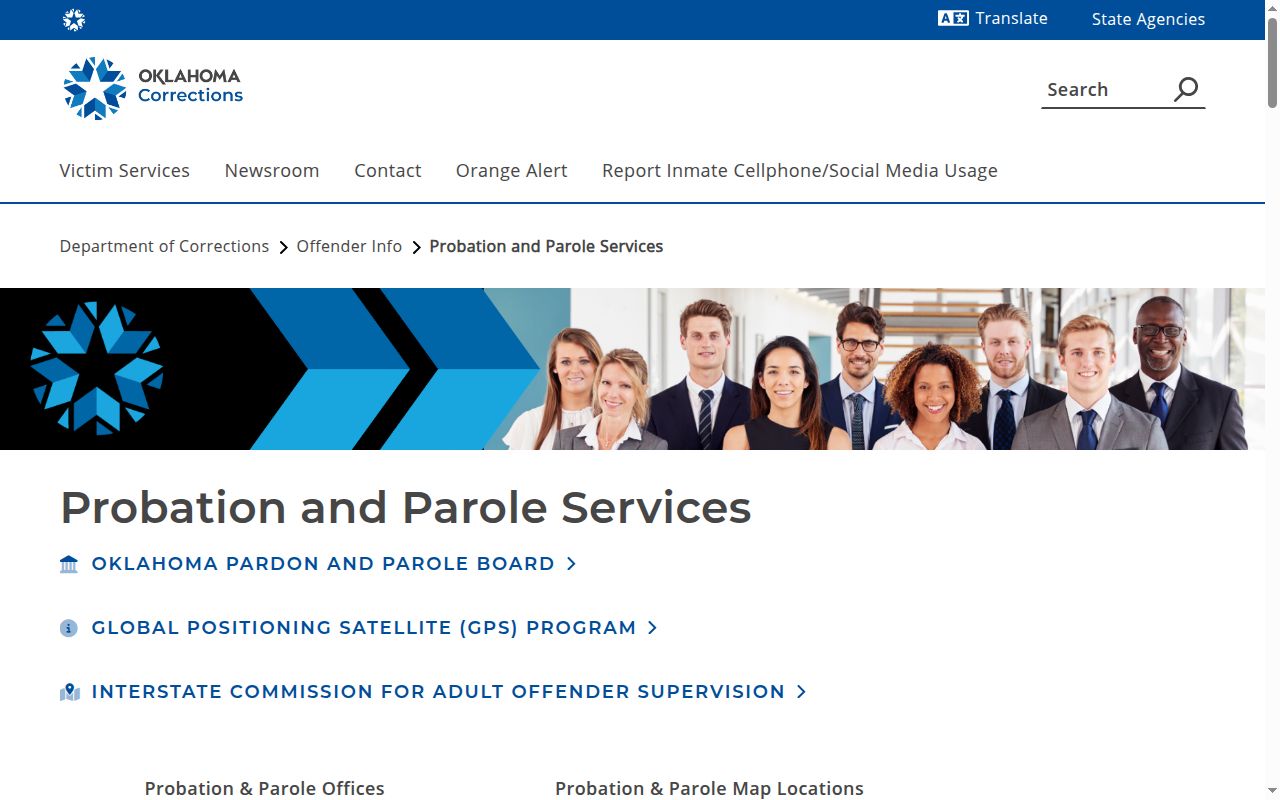
Kiowa County's geographic supervision office is outside the county. ODOC's official office list assigns both Kiowa and Washita Counties to the Cordell Probation and Parole office. The location is inside the Washita County Jail, which can surprise a caller who expects a Kiowa address. Geographic service does not guarantee that every specialized or transferred case is assigned there, so verify the individual case first.
County Jail
400 NE McClary Street
Cordell, OK 73632
580-832-5059
The ODOC Probation and Parole Services list is the source for this routing detail.
The captured office row ties Kiowa County to Cordell and helps prevent calls to an unrelated county office. The page's later “Inactive Counties” table concerns separate Community Sentencing Offices; it does not say ordinary Kiowa probation and parole service is inactive.
Kiowa County Parole Records Need Two Checks
The Oklahoma Pardon and Parole Board manages consideration, dockets, meeting records, and recorded results. ODOC manages custody, release implementation, and community supervision. Therefore, a person can appear on a parole docket without having left prison, and a favorable recorded action can still precede stipulations, detainer resolution, other sentences, release planning, or final state action.
Use the current PPB results legend and preserve its exact wording. Do not reduce every action to “granted” or “denied.” Next, check the actual ODOC custody change and assigned supervision status. OK VINE can report a contributing agency's custody event, but PPB states that ordinary VINE service does not provide parole notification. Its written victim-notification process is separate and may provide notice before a hearing and upon release to parole.
Eligibility is also not release. Oklahoma's rules under 57 O.S. §332.7 vary by offense date, offense category, and other exclusions. The Board can consider a matter before the eligibility date in some situations, but eligibility is never a promise of favorable action or physical departure.
For older offenses, §332.7 includes provisions tied to one-third calculations, age or matrix rules, and exclusions. Later offense-date ranges use different general fractions, and administrative parole has its own exclusions. Covered violent cases may also use a two-stage process. These differences make sentence-length arithmetic an unsafe substitute for the docket, result, current ODOC status, and actual release record.
Kiowa County Absconder and Warrant Records
No official online Kiowa County, Oklahoma warrant list was verified. Search results labeled “Kiowa warrants” may lead to Kiowa County, Kansas, which is a different jurisdiction. For a person alleged to have absconded from Oklahoma state supervision, use ODOC's dedicated fugitive search rather than an ordinary local roster or an out-of-state sheriff site.
The official ODOC fugitive and absconder path is separate from the general lookup.
A matching entry supports a wanted or absconder posture, not ordinary discharge and not proof that supervision ended. Do not approach anyone based on a search result. ODOC lists its Fugitive Warrants Division at 405-425-2570 or 405-425-2571, toll free at 866-363-1119, and at warrants@doc.ok.gov. Contact local authorities when there is an immediate safety concern.
Reading Kiowa County Supervision Conditions
Supervision conditions must come from the judgment, parole paperwork, or current ODOC record for that person. At a high level, supervision can involve reporting, approved residence or travel, program participation, financial duties, registration duties where applicable, and compliance with other court or agency terms. The exact conditions should never be guessed from the words “parole” or “probation.”
An alleged violation is not the same as a completed revocation. Check the Kiowa court docket for a probation revocation filing or order and ODOC for state supervision action. A VINE alert reports an agency custody event; it is not a judicial finding. Likewise, a public registry entry can establish a current registration record but does not show whether the person is on parole or probation.
Note: attach every status to its source, since a court filing, ODOC record, VINE event, and registry entry answer different questions.
Kiowa County Reentry Support for Eligible Clients
The Kiowa Tribe documents a Re-Entry Program in Carnegie for eligible tribal clients. Its pre-release plan addresses identification, transportation, legal issues and warrants, health continuity, registration duties, and supervision. It also distinguishes clients with no supervision from those on ODOC probation, post-imprisonment supervision, or supervision through another jurisdiction.
The Kiowa Tribe pre-release plan is a planning and service resource. It is not a custody locator, a Kiowa County agency, or the office that supervises an ODOC case. Its Carnegie program cannot confirm that someone left Kiowa County Jail, and it should not be presented as available to every released person. For an eligible client, however, the plan can help organize the practical steps that sit alongside official supervision.
Proving Kiowa County Supervision Discharge
Physical release and completed supervision should be documented separately. A person released on parole remains under supervision for the applicable balance. A probation term may end under the court and ODOC record. An old docket, a missing search result, or the absence of a fugitive entry does not prove final discharge.
ODOC Legal Services provides the closed-record and discharge route. Contact Closed Records at 405-425-2691 and use osordischarges@doc.ok.gov for discharge matters. The agency also provides an authorization process for incarceration or supervision records where needed. Ask for the existing record that states the relevant supervision or discharge event, and identify the person by DOC number when possible.
If dates disagree, label each date: Kiowa County jail discharge or transfer, ODOC admission, parole action, physical release, supervision start, and sentence discharge. Preserve both sourced dates until the custodian resolves the discrepancy. This approach keeps a parole record from claiming more than the Board decided and keeps a probation record tied to the actual court and ODOC documentation.
A completed court term and an ODOC supervision record may require separate confirmation. Search the Kiowa County docket for the judgment, deferred or suspended terms, revocation filings, and any later completion order, then obtain the filed document from the district clerk when the online entry is abbreviated. OSCN describes its online report as unofficial, so a docket display should not displace a certified order or the supervising agency's own discharge documentation.
If the sheriff's Kiowa County entry shows transfer to ODOC, preserve that county transfer date separately. It marks the end of local custody, not the start of parole or the completion of supervision. The receiving agency's record must document each later state event.