
Kiowa County Projected and Actual Release Dates
The Oklahoma Pardon and Parole Board defines a projected release date, or PRD, as ODOC's estimate of when release from prison will occur. It can move upward or downward as credits, program participation, and misconduct change. The Board does not calculate it. A PRD is not the date of a parole hearing, a promise that parole will be approved, or proof that someone walked out of a facility.
| Date or event | What it establishes | Who documents it |
|---|---|---|
| Projected release date | An ODOC estimate based on current sentence and credit information. | ODOC |
| Parole eligibility date | The earliest statutory consideration point under the applicable offense rules. | Law and PPB records |
| Parole docket or result | A scheduled Board proceeding or its recorded action, not physical release. | Oklahoma Pardon and Parole Board |
| County discharge or transfer | The end of Kiowa County Jail's custody and whether another agency received the person. | Kiowa County Sheriff |
| Actual prison release | The state custody change that occurred, subject to any ongoing supervision. | ODOC and agency-reported VINE data |
| Sentence discharge | Completion of the state term or supervision, which can occur after physical release. | ODOC discharge record |
How to Find a Kiowa County Release Date
The route depends on whether the person is in local pretrial custody, serving a local sentence, or committed to ODOC. Do not apply a prison credit table to every Kiowa County Jail booking. Identify the last custodian and use the record system for that part of the custody chain.
A pretrial detainee does not have an ODOC-style PRD merely because a charge or bond appears in court. Release may depend on satisfying a bond condition, a recognizance order, dismissal, a later hearing, or resolution of another hold. The filed court order supplies the legal authority, while the sheriff's jail record supplies the physical discharge or transfer time. Neither record should be made to answer the other's question.
- For Kiowa County Jail, call the sheriff at 580-726-3265 with full name, date of birth if known, and the approximate booking period. Ask whether the person remains there, left for the community, or transferred.
- Ask for the date, time, and manner of discharge, plus the receiving agency when the entry shows a transfer. A transfer to ODOC is continued custody, not release.
- For state custody, search the ODOC offender lookup by DOC number or by name and date of birth. Use alias or similar-sounding options with care and solve the CAPTCHA.
- Read the exact date label on the live record. ODOC describes its public data as abbreviated, and research did not verify a universal current-result label for every discharged person.
- Check the Kiowa court judgment or later order for the sentence, jail-time credit, concurrent or consecutive treatment, revocation, amendment, or other legal change. The court order explains authority but does not replace the custodian's exit time.
- For a future event, monitor the responsible agency. For a past event, obtain the existing jail or ODOC discharge record rather than reverse-engineering a date.
The Kiowa County release-record guide covers the local jail-register request and the differences between community release and transfer. No official Kiowa County roster or release archive was verified, so absence from a web list cannot answer when the person left.
For a locally served sentence, search the Kiowa County docket for the judgment, jail-time credit, later amendment, revocation, or completion entry. Obtain the filed order from the district clerk when the docket text is abbreviated. Then ask the sheriff for the existing entry that records the date and manner of discharge. If another jail held the person under an arrangement, that custodian may hold the physical transfer timestamp while Kiowa retains the case record.
ODOC's Kiowa County Release-Date Worksheet
ODOC's official attachment titled “PROJECTED RELEASE DATE” is a policy tool, not a personalized release certificate. It separates maximum, medium, minimum, and community security projections from categories such as GPS, EMP, CSP, and PPCS. The worksheet also uses multiple month columns, class levels, enhanced levels, and Ekstrand rows. Those categories show why a single sentence-length calculation is unreliable.
The official ODOC PRD worksheet includes the agency's projection tables and limitations.
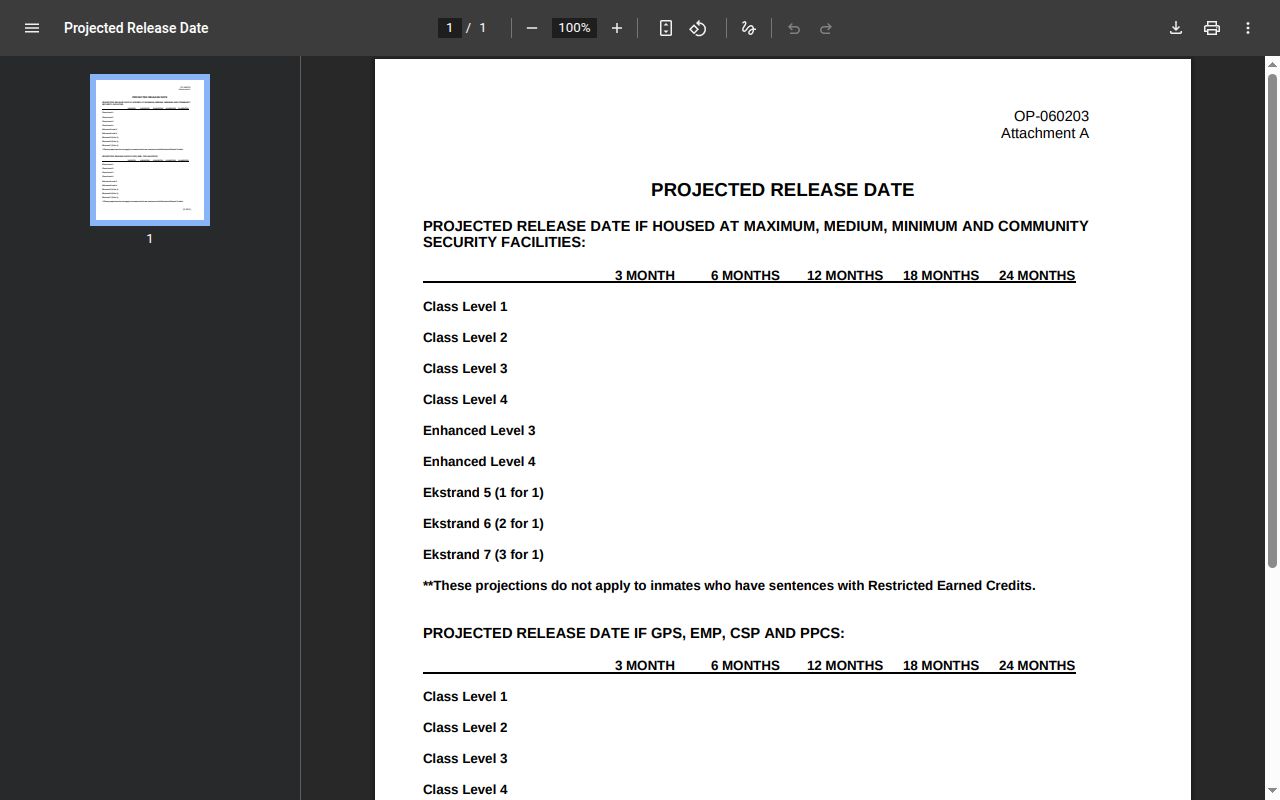
The worksheet warns that its projections do not apply to restricted-earned-credit sentences. It should be used to understand the agency framework, not to publish a date for a named person without the current ODOC record.
Note: the live ODOC record and Sentence Administration history control the individual calculation; a static worksheet cannot incorporate later changes.
Kiowa County Release Dates and Earned Credits
Oklahoma's earned-credit statute, 57 O.S. §138, ties monthly credits to class level and offense history. Class 1 receives no monthly credits, while class 2 receives 22. For a person ever convicted or adjudicated of an offense listed in subsection E, class 3 receives 33 and class 4 receives 44. For a person never convicted or adjudicated of a listed offense, class 3 receives 45 and class 4 receives 60. One credit represents one day deducted.
Classification is not just a calendar choice. ODOC considers work, education and program performance, conduct, cooperation, hygiene, and the living area. Credits may be removed for misconduct or nonperformance. Restoration can occur under policy, but ODOC describes restoration under subsection C as discretionary rather than an entitlement. The statute and policy also contain subsidiary achievement credits and restrictions that must be read before any case-specific estimate.
These state prison rules do not create a safe calculator for a local Kiowa County Jail sentence. A court may address jail-time credit, and the sheriff records the local discharge or transfer. Holds, another case, sanctions, and amended orders can all change the actual event. Ask the jail and court for the existing records instead of subtracting days from a sentence.
When Oklahoma's 85 Percent Rule Applies
Oklahoma's often-cited 85 percent rule is not universal. Under 21 O.S. §13.1, a person convicted of an enumerated crime must serve at least 85 percent of the sentence before parole consideration, and earned credits cannot reduce the term below that statutory floor. The offense must actually fall within the section. It is inaccurate to apply the percentage to every Oklahoma prisoner or every Kiowa County case.
The floor also should not be confused with other parole-eligibility rules in 57 O.S. §332.7, including offense-date provisions. Eligibility is a consideration point, not a PRD, Board decision, or release record. Restricted-credit status can also make ODOC's standard projection worksheet inapplicable. Read the current judgment, offense statute, and agency record together rather than relying on a slogan.
What Changes a Kiowa County Release Date
A projected date can move for more than one reason, and the public lookup may not explain every sentence-administration detail. Label the change before interpreting it. Two dates can both be accurate if one describes county transfer and another describes state intake or prison release.
| Factor | Possible effect | Record to check |
|---|---|---|
| Class-level movement | Changes the rate at which credits accrue. | Current ODOC sentence and classification record. |
| Misconduct or nonperformance | May remove credits and move a projection later. | ODOC record and applicable policy. |
| Restored or achievement credits | May move a projection earlier if law and policy allow. | ODOC calculation, not private arithmetic. |
| Restricted-credit sentence | Can make standard worksheet projections inapplicable or impose a floor. | Judgment, statute, and ODOC record. |
| Jail-time credit | Can alter the state sentence calculation after commitment. | Filed order and Sentence Administration record. |
| Concurrent or consecutive terms | Changes how multiple sentences run together or one after another. | Judgments and ODOC sentence record. |
| Detainer or another hold | May prevent community release even when one custody term ends. | Discharge or transfer record naming the receiver. |
| Amended court action | May correct or change the controlling sentence. | Filed amended order and updated ODOC record. |
| Parole action | May change the path to supervised release but does not itself prove departure. | PPB result plus ODOC custody change. |
Why Kiowa County Release-Date Math Fails
Oklahoma presents a public PRD concept while also cautioning that a particular future discharge date is tentative and may be confidential without legitimate need in an ordinary inquiry. The public lookup is intended to provide offense, projected release date, and photo information, yet ODOC warns that the lookup is abbreviated and has experienced data-source issues. These points are not contradictions when the date is treated as an estimate instead of a guarantee.
The strongest retrospective evidence is the agency's actual discharge documentation. ODOC Legal Services lists Closed Records at 405-425-2691 and provides osordischarges@doc.ok.gov for discharge matters. An authorization process is available for incarceration and supervision records where required. A record request should identify the person and ask for the existing sentence, custody, supervision, or discharge record rather than demand a fresh calculation.
The ODOC Legal Services record channel is the official fallback when the public lookup does not establish the event.
This route is especially important for a person formerly at the Hobart Community Work Center. That center is absent from ODOC's current list and must be treated as former, so historical custody and discharge belong in ODOC records rather than a current local facility search.
Confirm a Kiowa County Actual Release
For a local release, obtain the Kiowa County Sheriff's jail-register or release entry showing date, time, and manner of discharge. If the entry says transfer, continue with the named receiving agency. For state prison, use the current ODOC result for discovery and the discharge record when exact proof matters. For parole, pair the Board result with ODOC's physical custody change and later supervision documentation.
OK VINE can report release, transfer, escape, apprehension, and death events from contributing agencies, but the event is not a sentence-completion certificate and may not rule out another hold. The Kiowa County VINELink release check explains how to read an agency-reported event and register for notifications without confusing it with a projected date.
When two sources disagree, preserve the exact labels and agency names. Ask whether each date means PRD, eligibility, Board action, transfer, actual release, supervision start, or discharge. Do not “correct” an official date with a home calculation. ODOC Sentence Administration and the court that entered the judgment are the proper sources for a sentence discrepancy.